|
FISH IN THE TENERE (NIGER)
This is a discussion, and you are asked to add your knowledge and views
through
info@desertdiningclub.or.uk
If members have points to add to this page please send
them to
info@desertdiningclub.org.uk. The Web Master cannot guarantee
to publish everything sent. Photographs, especially where
illustrating a point, are welcome.
This page was last amended:
Sunday, 31 December 2006 |
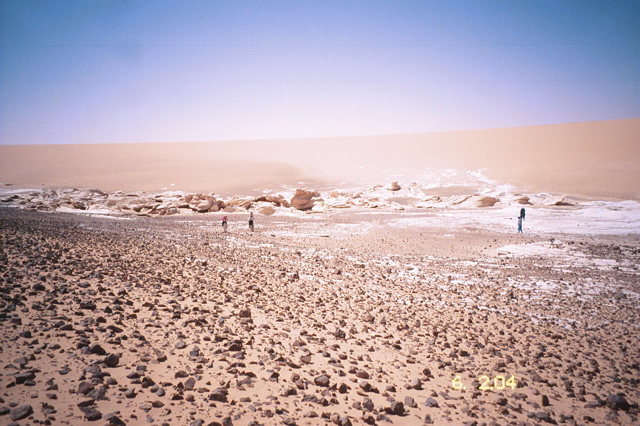
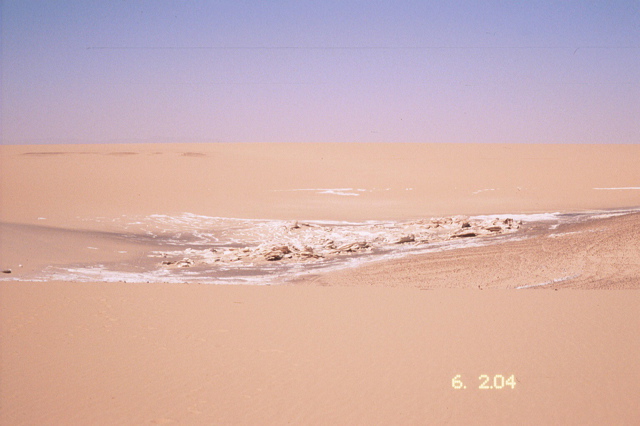
David and Lillis Lyon visited
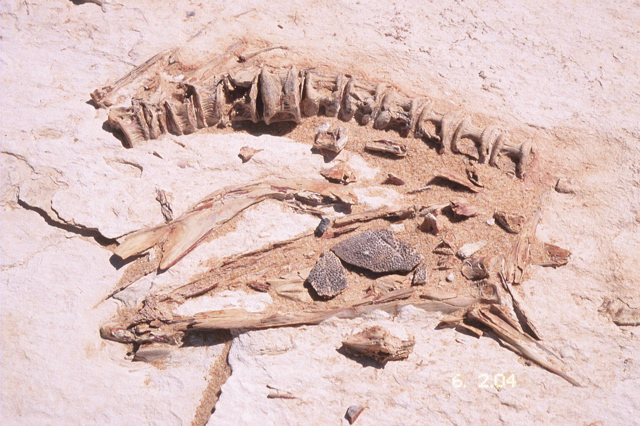
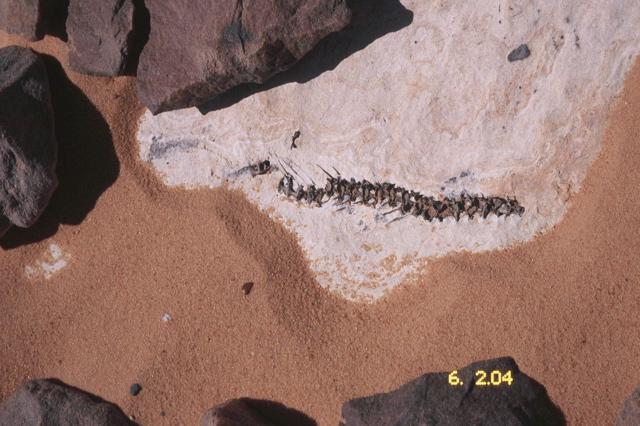
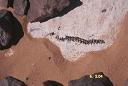
the Air and the Ténéré in 2004, and took photographs of fossilised fish
bones in the lake. His report records: "Lake of T-I-n Ouaffadene
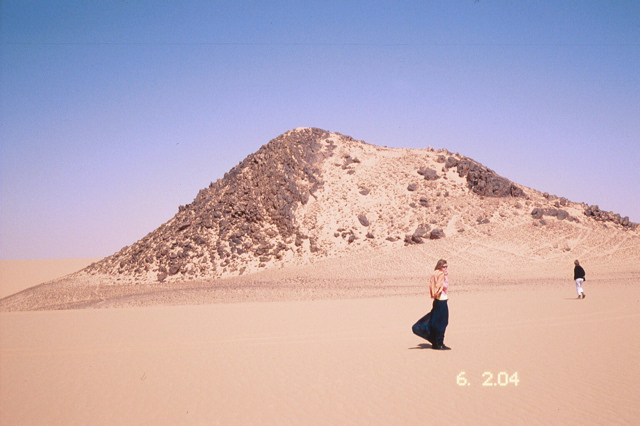
[N 2o 10 140 : E 9 10 571] with its little hill to the west clearly
visible on the otherwise flat horizon from 30 km away.
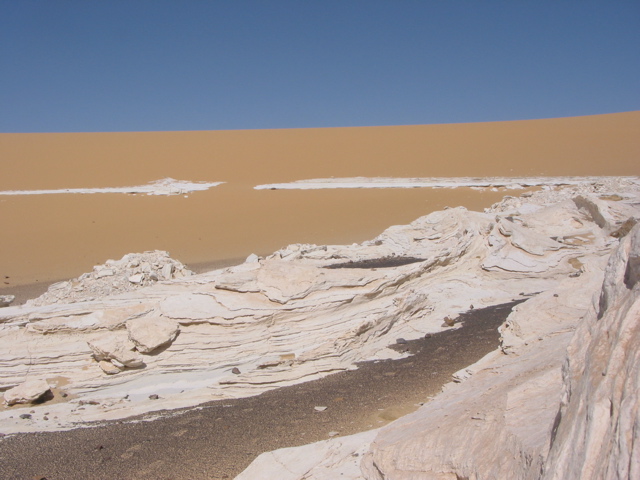
The dried up lake is about 500m in diameter and has number of calcareous
deposits of varying thickness within it.
There are numerous pieces of skeleton in the deposits and the sand bed
of the lake including fish skeletons. At the margins of the lake are
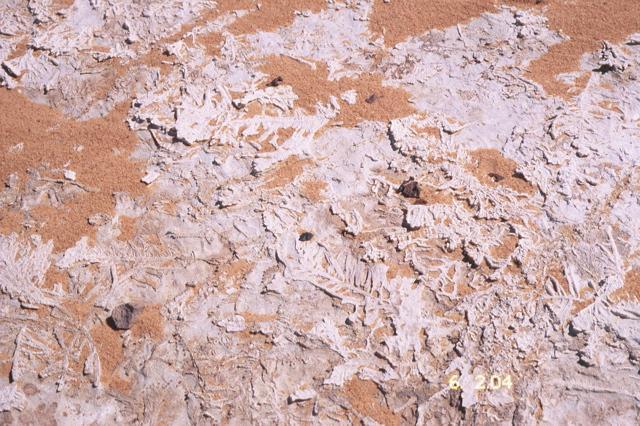
calcified ferns."
Click on photo to enlarge
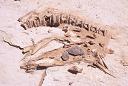
Fish bones. What sort of fish? |
More fish bones. What species? |
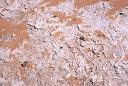
Photo of the 'calcified ferns' on the lake margins. |
David
Hall, at first sight thought the picture on the left showed a camel
skeleton, but later wondered if the fish was a cat fish. Dr David
Thomas (member of the Club) said: "My first reaction as a zoologist
to your photo
was that the vertebrae look very fish-like: simple "cotton reels"
(albeit with attenuated waists) abutting end-to-end and pretty
undifferentiated one from another. Such structures work very well for
swimming fish, all of whose weight is supported by the water: the
vertebral column has mainly to resist longitudinal compression resulting
from trunk muscle contractions, and allow the body to flex laterally
during swimming. Terrestrial vertebrates (whose vertebral columns now
have to support body weight as well as flexing with locomotion)
typically have adjacent vertebrae with bony processes interlocking &
articulating with one another to maintain the integrity of vertebral
column axis under loads which aren't parallel with the axis. Vertebrae
of terrestrial vertebrates also have dorsal and lateral processes for
muscle attachment (see any sheep skeleton next time you walk in the
hills). When you get to something the size of camels, the loads are
large and these various bony processes on the vertebrae are
correspondingly well developed."
The late Professor J Desmond Clark talked of the 'Old Neolithic' hunters
and fishers around the swamps had a diet which included Nile perch and
mudfish. (in Geogr. J. 137,4456).
What are the fish? Are they cat fish, Nile perch or 'mudfish'?
How big have been the fish found in the Ténéré?
What of the calcified ferns?
COMMENTS WELCOMED TO
info@desertdiningclub.org.uk
RESPONSES:
1. Mike Saunders, Deputy Leader of the British Expedition
to the Air Mountains 1970, writes: "I remember going to the lake
(Lake of T-I-n Ouaffadene)
by the cimetiere des Addax, and helping to lift a complete fossilised
fish, looking like, and said by the cognoscenti to be, a catfish.
It was complete, embedded in a matrix of diatomite so that you could see
all of one side of it, and it was about 18 inches long. I seem to
remember that it came from near the top of the steep bank, the top of
which was said to mark the lake shore line. There were also many,
many snail shells there, I think mainly the long thin conical sort about
1/2 inch long. The Latin name escapes me, but they were like the
snails which were found in slow moving water and which are vectors
for the schistomsome parasite. We did not see live addax, but saw
plenty of addax skeletons. (Received 27 December 2006)
2. Professor Martin A J Williams, geographer,
geomorphologist, Quaternary geologist, and Foundation Professor of
Envirnmental Studies, University of Adelaide. As a member of
the British Expedition to the Air Mountains 1970, he, with the
late Professor J Desmond Clark (Berkeley) and Professor Andy Smith (Cape
Town), spent three months working at Adrar Bous and the area to the
south of it. He comments:
We paid two brief visits to Tin Ouaffedene, an
isolated flat-topped hill of
greywacke sandstone and quartzite located ~30 km SE of Adrar Bous. On
some of
the older small-scale maps it appears as 'Piton Isolé' or as 'Cimetière
des
Addax'. We gave it the informal name of 'Piton Faure' in honour of the
geological research conducted in this region by Professor Hugues Faure.
On
later 1: 100 000 scale maps it appears as Tin Ouaffedene which appears
to be its
correct local name.
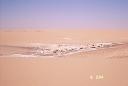
Click
on photo to enlarge
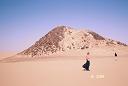 Piton
Isolé, Piton
Isolé,
Cimetière des Addax, or
Piton Faure
|
 |
 |
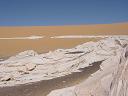
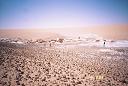
Diatomite on the ancient lake bed.
Pictures by David Lyon (2004)
|
The hill is surrounded by a peripheral wind-scoured depression or
deflation
hollow ~30 m deep. Wind-eroded remnants of diatomite crop out on the
floor of
the depression and to heights of 15 m above the floor of the
depression. The
approximate elevation of the top of the diatomite is 655 m. A
well-defined break
of slope at 670 m probably marks the upper limit of the lake. Beneath
the break
of slope there is a small scarp comprising 30 cm of grey-brown vesicular
clay
loam over 60 cm of massive brown sandy loam. The vesicular clay loam
grades
into a vesicular ferricrete. We recovered fish bones and shells from
one
section (section A of 7/2/70) 2-3 m beneath the uppermost diatomite
surface.
From the top down, section A comprised 3 cm of diatomite with fish bones
over 22
cm of grey medium sand with shells over 20 cm of white silt with very
fine
charcoal over a further layer of diatomite. Two shell samples were
collected
for radiocarbon dating and yielded statistically identical ages of 9
570±130 BP
(SUA-2718) and 9 610±230 BP (SUA-2719). The dates were subsequently
confirmed
by ages of 9220 and 9260 BP reported by Roset et al. (1990). [They are
also
statistically identical to ages of 9130, 9100 and 9030 BP from Diatomite
I at
Adrar Bous]. These ages indicate that the uppermost diatomite at this
site was
coeval with the highest levels attained by Lake Chad during the Holocene
(Servant 1973, Servant and Servant-Vildary 1980). Considerably more
detail is
now available from this site as a result of the PALHYDAF drilling
project.
Fontes and Gasse (1991) provided an excellent summary of this work and
Dubar
(1984) has given a detailed analysis of the diatoms with some additional
radiocarbon dates similar to ours.
The Piton Faure radiocarbon dates obtained by me are:
SUA-2719 : 9, 610 +/- 230 years BP
SUA-2718: 9, 570+/- 130 years BP
These are radiocarbon years and not calendar years.
Key references:
Williams, M.A.J., Abell, P.I. and Sparks, B.W. (1987). Quaternary
landforms,
sediments, depositional environments and gastropod isotope ratios at
Adrar Bous,
Tenere Desert of Niger, south-central Sahara. In: Frostick, L. and Reid,
I.
(eds) Desert Sediments: Ancient and Modern. Geological Society Special
Publication No. 35, pp. 105-125.
Dubar, C. (1984) Eléments de Paléohydrologie de l'Afrique Saharienne:
les dépôts
quaternaires d'origine aquatique du Nord-Est de l'Aïr (Niger, PALHYDAF
site 3).
Docteur en Sciences thesis, Université Paris-Sud, Centre d'Orsay, 170
pp.
|